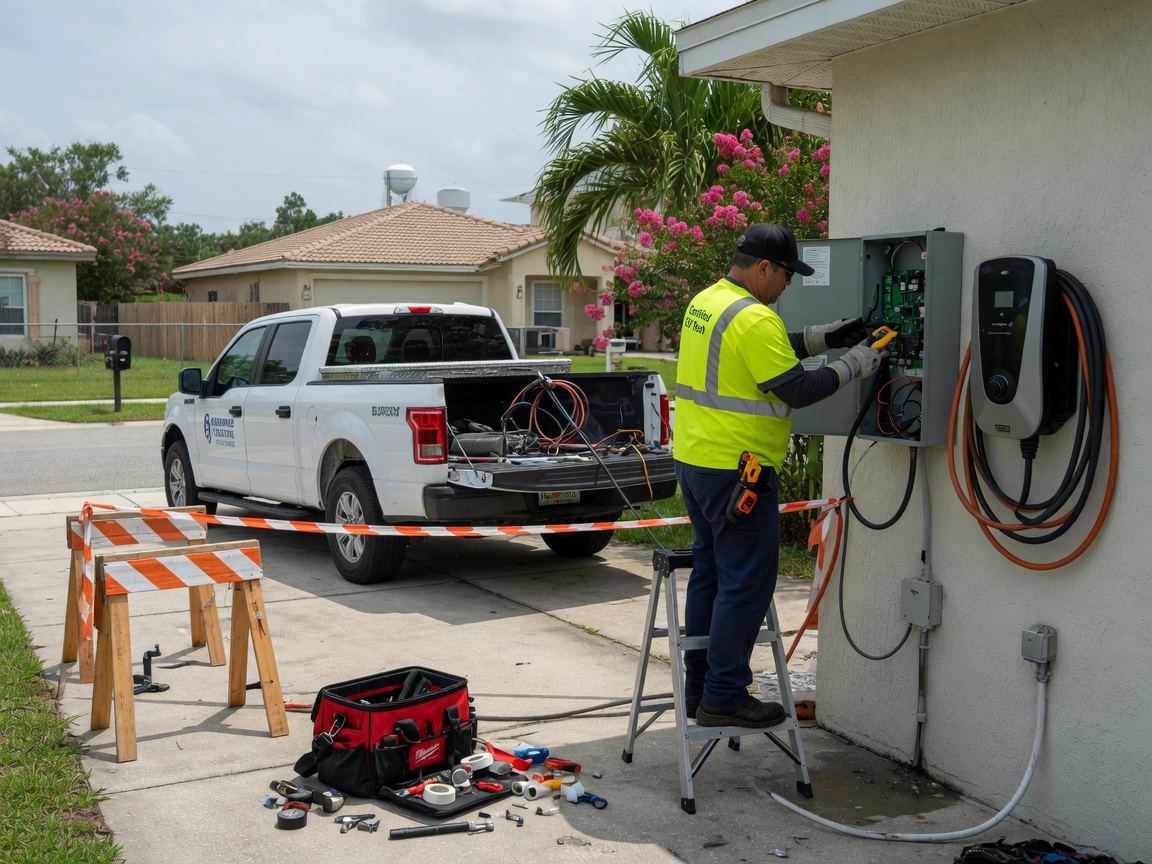
Kissimmee’s humid subtropical climate brings frequent moisture that corrodes EV charger connectors and outdoor enclosures, especially on units mounted near Lakefront Park or in Buenaventura Lakes where afternoon storms are common. Older homes in the Kissimmee Historic District often have 60-amp or 100-amp panels that cannot support a 40-amp or 50-amp Level 2 charger without a panel upgrade or new dedicated circuit. Electricians here routinely run new 6 AWG copper conductors in conduit from the main panel to a garage or driveway location, then install a NEMA 14-50 or hardwired unit while maintaining proper GFCI protection required by current Florida residential code.
Hot summer loads push many chargers to their thermal limits, so proper derating and ventilation become critical when units are placed in enclosed carports common in Osceola County subdivisions. In neighborhoods around Old Town Kissimmee, underground service laterals and shallow trenches can complicate conduit runs, requiring careful coordination with irrigation lines and existing low-voltage wiring. Technicians check torque on all lugs, verify voltage drop under load, and confirm the charger communicates correctly with the vehicle before leaving the site.
Storms and lightning are frequent in central Florida, so surge protection at both the main panel and the charger itself prevents damage that would otherwise require full unit replacement. When a charger fails, common issues include ground-fault trips from moisture ingress, failed control boards after power surges, or damaged cables from vehicle impact. Repair work starts with isolating the circuit, then replacing only the failed component when possible rather than the entire unit.
Technician insight
In Kissimmee the thing that catches most people out with EV Charger Repair and Installation is moisture getting into outdoor units mounted on older stucco homes in Buenaventura Lakes; the humidity here rusts terminals faster than inland spots, so we always pull the unit and check the seal even when the complaint sounds like a simple breaker trip.
Charger Failure After Summer Storms
A homeowner in Buenaventura Lakes reported repeated ground-fault trips on a two-year-old charger. We found corroded pins inside the handle from repeated rain exposure. After replacing the cable assembly and adding a better weatherproof cover, the unit has operated without interruption through the next rainy season.
EV Charger Repair and Installation Services We Offer
✓Level 2 Charger Installation
Install a 240-volt hardwired or plug-in charger with new dedicated circuit sized for your vehicle and panel capacity.
✓EV Charger Diagnostics and Repair
Troubleshoot ground faults, communication errors, and thermal shutdowns common in Kissimmee’s humid environment.
✓Panel Upgrade for EV Charging
Replace or expand the main panel to safely add the amperage needed for reliable Level 2 charging.
✓Outdoor Charger Enclosure and Surge Protection
Add weatherproof housing and whole-panel surge devices to protect against Osceola County storms and moisture.
✓Charger Relocation and Circuit Extension
Move an existing charger to a new driveway or garage location with proper conduit and conductor sizing.
EV Charger Repair and Installation Cost in Kissimmee, FL
| Service | Typical Range | What Affects It |
|---|---|---|
| Level 2 Charger Installation | $900–$1,800 | Varies with panel distance and whether a new circuit or panel upgrade is required |
| EV Charger Repair Visit | $150–$450 | Diagnostic fee applied toward repair; parts extra |
| Panel Upgrade For EV Charger | $1,800–$3,200 | Depends on amperage increase and whether service entrance conductors must be replaced |
| Charger Relocation | $600–$1,200 | Includes new conduit run and reconnection |
Ranges are typical for Kissimmee, FL and confirmed with an exact written quote before any work starts.
How it works
- 1
Site Assessment
Evaluate panel capacity, wiring condition, and mounting location while noting any moisture or corrosion issues from local humidity.
- 2
Load Calculation And Plan
Determine required circuit size and confirm the upgrade path if the existing service cannot support the charger.
- 3
Installation
Run new conduit and conductors, mount the charger, and make final connections with torque verification.
- 4
Testing And Handover
Perform load test, verify GFCI operation, and walk through daily use and basic troubleshooting.
Pricing
Upfront quotes after on-site assessment; final price depends on panel condition and run length. Call during business hours for scheduling.